
Top 10 Search Engines in 2026: AI, Privacy, and SEO Trends
by Admin | March 03, 2026
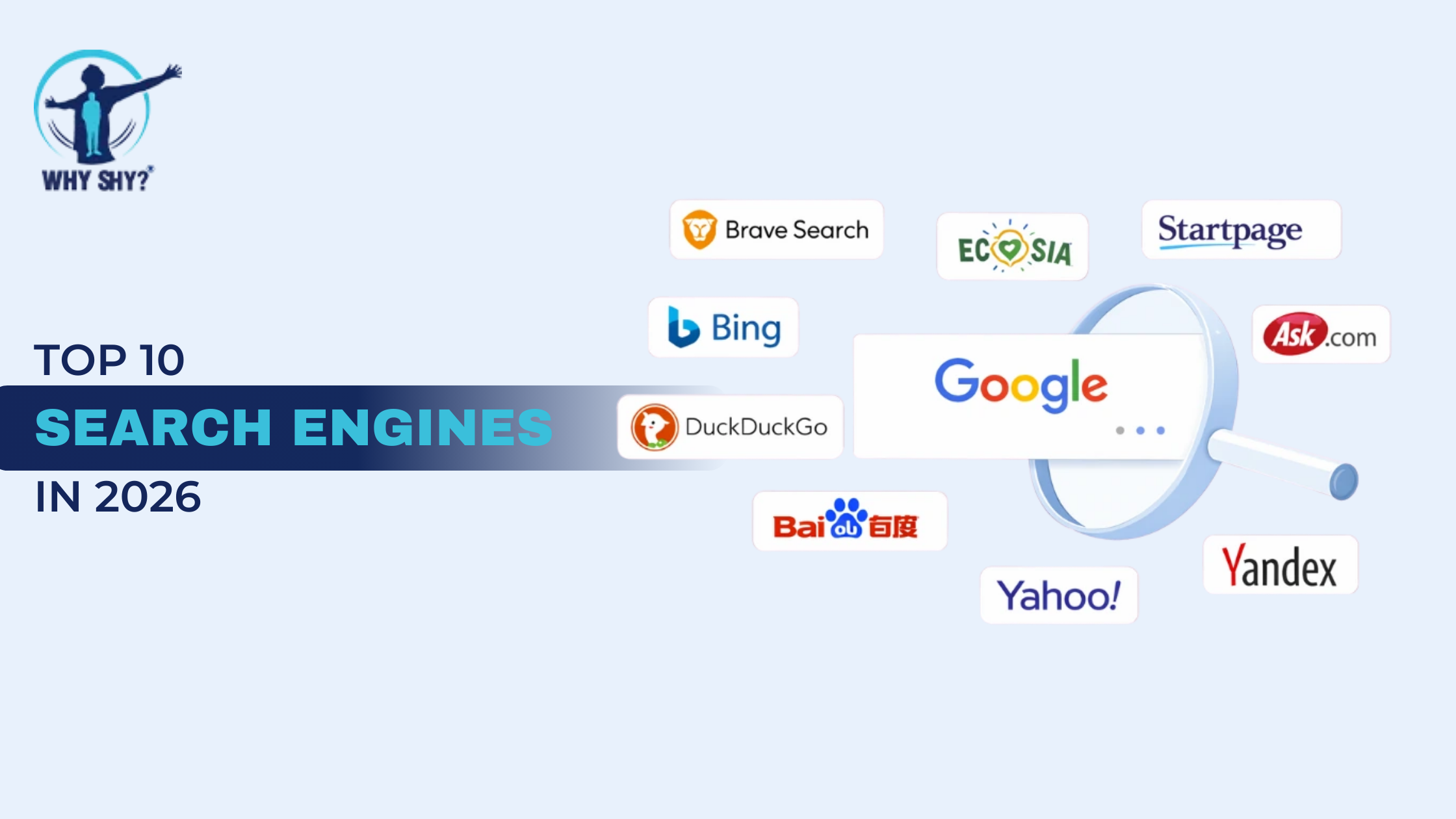
Top 10 Search Engines in 2026: AI, Privacy, and SEO Trends
In the fast-paced world of digital marketing, staying ahead means knowing where your target market is looking. As we flow into 2026, the landscape of the top 10 search engines like Google has shifted from a predictable monopoly to a fascinating mix of AI-pushed powerhouses, privacy-first bastions, and area of interest network hubs.
At Why Shy, we understand that visibility is not pretty much ranking on page one anymore; it's about being present wherein the conversation starts. Whether you're a business proprietor trying to decode search engine basics or a marketer looking to refine your method, this guide breaks down the modern-day state of search.
Key Takeaways
- Google Still Leads, but the Gap is Closing: Google maintains over 90% market share, but AI competitors and social search are siphoning off younger demographics.
- The Rise of AI Overviews: Search is moving from "links" to "answers." Most major players now integrate generative AI directly into the results page.
- Privacy is a Product: Users are increasingly migrating to engines like DuckDuckGo and Brave Search to escape aggressive data tracking.
- Social Search is Real: For Gen Z, Instagram is effectively functioning as top search engines for lifestyle and product discovery.
Also Read: Top 10 Social Media Marketing Agencies in Gurgaon (2026 Guide)
Understanding Search Engines and How They Work
To master the virtual area, you first want to answer a fundamental question: what is search engine technology today? At its core, a search engine is a software device designed to perform web searches. They work through three primary levels: Crawling (coming across content material), Indexing (storing and establishing content material), and Ranking (retrieving the most relevant results for a consumer).
However, in 2026, the "how" has evolved. Traditional keyword matching has been changed by semantic knowledge. Modern search engines now use Large Language Models (LLMs) to recognise the rationale behind a query, not just the words themselves.
Organic Results vs. Ads: What the Difference Means for Users
When you perform a search, you typically see two types of results:
- Organic Results: These are the listings that "earn" their spot through high-quality content and SEO. They are perceived as more trustworthy by users.
- Paid Ads: These are the "Sponsored" links at the top. While they offer immediate visibility for businesses, savvy users often skip them in favour of organic listings.
Understanding this balance is part of search engine basics. If you rely solely on ads, you lose credibility; if you ignore SEO, you lose traffic.
Top 10 Search Engines in the World
Here is the definitive list of the top search engines dominating the web in 2026, ranked by a combination of market share, innovation, and user growth.
1. Google
The undisputed king. With more or less 90.04% of the global marketplace, Google remains the primary goal for most search engine optimization efforts. In 2026, Google has leaned heavily into its "AI Overviews," providing synthesised solutions at the top of the web page. For brands, this indicates "0-click on searches" are at an all-time high, making excessive-authority content material extra essential than ever.
Read More: Top 10 Best Website Designing Companies in Gurgaon for 2026
2. Bing
Microsoft’s Bing has enjoyed a resurgence, now commanding approximately 4.31% of the marketplace. Its deep integration with OpenAI’s technology and its presence as the default on Windows devices have made it a formidable #2. Bing is especially sturdy within the US laptop marketplace, in which its percentage frequently climbs above 10%.
3. Baidu
If you're trying to enter the Chinese market, Baidu is your gateway. It controls over 77% of the search market in China. Because Google is blocked there, Baidu has evolved its very own atmosphere of AI and nearby services that are important for nearby search engine marketing.
4. Yahoo!
The Yahoo search engine remains a consistent participant, holding about 1.45% of the marketplace. In 2026, Yahoo released "Scout," an AI-powered search engine designed to simplify complicated queries. It nonetheless draws a big target audience via its Finance, News, and Mail integrations.
5. DuckDuckGo
The champion of privacy. DuckDuckGo doesn't store your records or promote your statistics. While its market proportion hovers around 0.89% globally, it has a fiercely dependable user base that is developing as information privacy issues turn out to be mainstream.
Also Read: Top PPC Services in India 2026 | Best PPC Advertising Companies
6. Yandex
Dominating the Russian-speaking global market, Yandex holds about 1.86% of the worldwide market share but over 60% in Russia. Like Google, it gives a full suite of services, from maps to cloud storage, making it an important hub for Eastern European site visitors.
7. Ecosia
Known as the "search engine that plants trees," Ecosia makes use of its ad sales to fund reforestation. It has ended up a favourite for eco-aware Gen Z and Millennial customers. It currently partners with Qwant to construct a European-primarily based seek index to lessen dependence on US tech.
8. Brave Search
Brave is a rising star in 2026. Built with the aid of the creators of the Brave Browser, it uses its very own independent index of the web (over 40 billion pages). It’s speedy, private, and increasingly more utilised by developers and tech enthusiasts.
Read More: Top 5 Local SEO Companies in 2026: Dominate Your Neighbourhood Search
9. Startpage
Startpage calls itself "the arena's most private search engine." It’s precise as it provides Google’s notable search effects but strips away all tracking and private information collection. It’s Google effects without the Google surveillance.
10. Ask.Com
A traditional name that still hangs on. While it has transitioned more right into a "Question and Answer" format, it nevertheless processes an enormous quantity of searches, especially among older demographics who pick its trustworthy format.
Quick Comparison Table
|
Search Engine |
Best For |
Privacy Rating |
Primary Region |
|
|
Comprehensive Info |
Low |
Global |
|
Bing |
AI Integration |
Medium |
USA/Europe |
|
DuckDuckGo |
Privacy |
High |
Global |
|
Baidu |
Local Chinese Content |
Low |
China |
|
Brave |
Tech-Savvy Users |
High |
Global |
|
Ecosia |
Social Impact |
Medium |
Europe |
Diversify Your Search: Ranking Outside of Google
For a long time, the digital marketing world was obsessed with one thing: staying on Google’s good side. But as we navigate 2026, putting all your SEO eggs in one basket is no longer a strategy, it’s a risk. The top 10 search engines are more diverse than ever, and a new breed of "Answer Engines" is changing the rules of the game.
To truly scale, you need to understand how to rank across different platforms. This isn't just about duplicating your Google strategy; it’s about understanding the unique "logic" of each ecosystem.
Read More: How to choose the best digital marketing agency in Gurgaon for Your Business
The Rise of the AI Search Engine
The biggest disruptor in 2026 isn't a traditional crawler, it's generative AI. Platforms like ChatGPT Search, Perplexity, and SearchGPT have moved from being "chatbots" to becoming primary search engines for millions. In fact, ChatGPT Search now handles nearly 18% of global queries, eating directly into Google's long-standing dominance.
Unlike traditional search, these AI engines don't just give you a list of links; they synthesise an answer. Ranking here requires a shift from SEO (Search Engine Optimisation) to GEO (Generative Engine Optimization).
How to Rank on AI Search Engines:
- Be the "Citation" Source: AI models prioritise content that is easy to summarise. Use clear, declarative "Definition Blocks" in your first 100 words. (e.g., "A search engine is...").
- Focus on Entities, Not Keywords: AI understands relationships. Instead of repeating a keyword, talk about the "entities" around it. If you're talking about smartphones, mention processors, screen tech, and operating systems in a way that shows deep search engine basics and topical authority.
- Prioritise Directness: AI search engines like Perplexity favour "Answer-First" formatting. Start your section with the answer, then provide the supporting data.
Also Read: Best Times to Post on Social Media in 2026: The Ultimate Guide by Why Shy
Strategy for Alternate Platforms
Beyond AI, ranking on other top search engines requires a tailored touch:
- Bing & Yahoo: Both engines place a higher weight on "official" site signals and social media presence. If your brand is active on LinkedIn or X (formerly Twitter), Bing is more likely to trust your site.
- DuckDuckGo: Since this engine doesn't use "search history" to rank you, your on-page SEO must be flawless. They rely heavily on the immediate relevance of your content to the specific phrase typed.
- Visual & Social Search: For many users, search engines are now TikTok or Pinterest. Ranking here isn't about meta tags; it's about "searchable" captions and high-engagement visuals.
Why Diversification is Your Best Defence
At Why Shy, we’ve seen brands lose traffic overnight because of a single Google algorithm core update. By diversifying your presence, optimising for the Yahoo search engine, building authority on Perplexity, and maintaining a clean index on Bing, you create a "safety net" for your traffic.
Success in 2026 means being the answer, no matter where the question is asked. Whether it's a privacy-focused user on Brave or a researcher using an AI agent, your brand needs to be the credible source they find first.
Conclusion
The era of the "one-size-fits-all" search is over. While Google remains the leader, the emergence of the top 10 search engines of 2026 shows a clear trend toward user empowerment. Whether it’s the tree-planting mission of Ecosia or the iron-clad privacy of Brave, users are choosing platforms that align with their values.
For your business to thrive, you must look beyond the "blue links." You need to be where your customers are asking questions, whether that’s a traditional search engine, an AI chat interface, or a social discovery app.
FAQ
Q1: Which are the top 10 search engines?
Currently, the top 10 search engines are Google, Bing, Baidu, Yahoo, DuckDuckGo, Yandex, Ecosia, Brave Search, Startpage, and Ask.com.
Q2: What is the #1 search engine in the world?
For decades, Google had been the #1 search engine, holding over 90% of the global market share as of early 2026.
Q3: What is stronger than Google?
In terms of raw market share, nothing. However, in terms of user trust and privacy, engines like DuckDuckGo and Brave are often considered "stronger" alternatives by privacy advocates.
Q4: What do Gen Z use instead of Google?
Gen Z is increasingly using TikTok and Instagram for discovery. For research and complex questions, many are turning to AI-native tools like Perplexity or ChatGPT Search.